Friday, January 22, 2016

Beyond Bombings: The Islamic State in Southeast Asia


Beyond Bombings: The Islamic State in Southeast Asia

Note the importance of the tactics being used includes hostage-taking and kidnapping:

On 30 June 2015, a Malaysian court convicted a man and his son for fighting with ISIL and planning terrorist incidents at home. But it was not a wave of bombings they were plotting, but rather the kidnapping of politicians.  While hostage taking, executions and barricade style attacks garner less concern from security services than bombings, this is potentially an important development at both the tactical and strategic levels for Southeast Asian militants.  If we are to understand the real impact of ISIL on Southeast Asian militancy, it is this.
Hostage taking has become the face of ISIL terror in the Middle East....

Read more [HERE].

Sunday, January 17, 2016

Verbal Communication & Text Messaging in Crisis Negotiation


ABSTRACT:
While the use of mobile phones and text messaging has made it easier for hostage negotiators to communicate with other law enforcement personnel in crisis situations, little research has examined how text messaging could be used to communicate with the perpetrator. The purpose of this preliminary, qualitative study was to explore the similarities and differences in communication patterns of two hostage negotiations, one that took place verbally and one that occurred through text message. 

Both transcripts were analyzed using the Crisis Communication Rating Scale (CCRS), a behavioral coding system developed by McClain (2004). The study provided initial insight into several important similarities and differences between the modes of communication. First, the hostage negotiator relied heavily on the use of personal and situational disclosures to resolve the situation, regardless of the mode of communication. 

Additionally, both the hostage negotiator and barricaded suspect used reflective statements more frequently when they were able to communicate verbally. Lastly, when communicating through text message, the hostage negotiator used persuasive statements more frequently, while the barricaded suspect used expressive statements of anger more frequently. Possible implications for training and practice are discussed. 

Full paper [HERE]. 

Wednesday, January 13, 2016

In This Corner: The Conflict Paradox


IN THIS CORNER: The Conflict Paradox
By Lynne Kinnucan  
With his newest book, The Conflict Paradox, Dr. Bernie Mayer joins the likes of Aristotle, Voltaire, Chesterton and Escher in their fascination with paradox: the contradiction that is not.

The Conflict Paradox is a book infinitely rich in its variety, worth reading again and again as the reader’s understanding grows and reshapes itself in interaction with it.  However, it is a disaster if you are the sort of person who underlines the important parts of a work. My own copy looks like it went through the printer backwards and forwards.

Dr. Mayer’s goal in writing the book was to “challenge the fundamental way we think about conflict itself.” And he has done it.  Focusing on the “polarized, bifurcated view we take of conflict,” he notes that the more aggressive the conflict, the more we are apt to regress to primitive, oppositional thinking, and from there to greater conflict. With a deeper understanding, we can see that the assumed polarizations are not only part of each other but, in fact, need each other to be complete (think DNA strands). 

 The book is structured around the seven core dilemmas posed in any conflict:

Monday, January 11, 2016

NYPD Hostage Negotiators On How To Persuade People: 4 New Secrets

 
I’m pretty sure I just heard a gunshot. And that means she’s dead.
 
Hold on, I guess I better back up and explain…

A 911 call came in. A domestic dispute turned into a hostage situation. The perpetrator has a gun on his wife and child.

ESU (Emergency Services Unit, basically, the SWAT team) arrived, as did 4 NYPD hostage negotiators. And me.

We stacked up outside the door to the apartment. But things were not going well. Shouting between the husband and wife was preventing Liz, the lead negotiator, from making much headway. She repeated her question:

“Is Erin okay?”

The perpetrator screamed back, “You’re taking her side because you’re a woman!”

Chris, one of the other negotiators hands her a post-it note: “Should we swap in a male negotiator?”

Liz considered it, then replied to the perpetrator:

“But I’m talking to you, Grant, not her.”

This seemed to calm him down. Chris nodded and crumbled up the post-it note.

Read more from the popular blog by Eric Barker (it's a must read) [HERE].

Sunday, January 10, 2016

NYAHN 1 Day Seminar


The New York Association of Hostage Negotiators and the Canadian Critical Incident Inc. are excited to present a one day seminar Tuesday, March 1, 2016 located at the Marriott Niagara Falls Ontario (more info to follow on hotel pricing and location). 
This seminar is a must for Incident Commanders, Tactical Officers and Crisis Negotiators to enhance their knowledge and skills in dealing with the radicalized home grow extremist.

Wednesday, December 16, 2015

Talk the talk: negotiation with Somali pirates


“Somali pirates can be clever, aggressive negotiators and they are quick to take advantage if they see weakness,” says Mr Edwards.

“You have to be robust, but at the same time you have got to show that you understand how the negotiation process works.”

In agreeing the price of exchange and executing the deal, there is a world of pitfalls and subterfuge. And after five years of dealing with hijackings off the Somali coast, Leslie Edwards has learnt nearly every pirate trick in the book.
These days, whenever the former British Army officer is called in to negotiate a ransom, he brings a checklist of “pirate tactics” with him.
So far he has counted 37 different ruses and manoeuvres. Some are more sophisticated than others, but all are designed to strike fear into the ship owners he works for and, ultimately, drive up the price paid.

Read more from the Telegraph.co.uk [HERE]

Tuesday, December 8, 2015

How To Negotiate With A Terrorist Organization


This is from earlier in the year but worth listening to anyway to get insight on negotiation strategies regarding ransom and terrorist incidents.

Enjoy:


(Via HereAndNow.WBUR.org) Nigerian officials believe the nearly 300 schoolgirls kidnapped by the Islamist extremist group Boko Haram have been split up and sent out of the country.
Hostage negotiators will be among the team of experts the U.S. is sending to Nigeria to help find them.
Clint Van Zandt is the FBI’s former chief hostage negotiator and he tells Here & Now’s Robin Young that the U.S. negotiators must first locate a Boko Haram member with authority to broker a deal.
Van Zandt says then they will advise on any ransom demands and most likely negotiate through a third party, like a family or company.

Friday, December 4, 2015

WSHNA 2016 Conference

WESTERN STATES HOSTAGE NEGOTIATORS’ ASSOCIATION
WSHNA is on Facebook or www.wshna.com
Next Conference - April 24 to April 27, 2016
Riverhouse Hotel & Convention Center, Bend, Oregon

PRESS RELEASE

The Western States Hostage Negotiators' Association (WSHNA) is excited to announce
their 30th Annual Training Conference and host to the Annual Meeting of the National
Council of Negotiation Associations (NCNA).
April 24, 2016 to April 27th, 2016 at the Riverhouse Hotel &
Convention Center, Bend, Oregon

Full information at www.wshna.com. WSHNA is also on Facebook under our full name.
Our web site includes presenter information, hotel information, and on-line registration
and payment.

The goal of the association is to develop in members a higher degree of proficiency in the
performance of their professional duties. The association shall provide training for members,
and the association shall act as a resource and conduit for information sharing.
WSHNA depends upon your involvement as a member to accomplish these goals. WSHNA
represents police & corrections crisis negotiators from Alaska, British Columbia, Hawaii, Idaho,
Montana, Nevada, Oregon, & Washington.

WSHNA is recognized as a tax exempt, non-profit organization, 501(c)(3), by the Internal
Revenue Service and Washington State. Tax numbers are available upon request.

Conference Contact Information
Sgt. Dan Ritchie, dritchie@bendoregon.gov

Organizational Contact Information
Bruce A. Wind, Director of Communications
2416 46th AVE SE, Puyallup, WA 98374-4181
email at bawind@comcast.net (preferred) or 253-446-6119

Monday, November 30, 2015

Crisis Negotiation- The Court Case That Decided How It Should NOT Be Done

For new negotiators and old, this paper is worth reading. It give a full overview and the long-term impact it had with crisis and hostage negotiations in the U.S.

It's a "must read" for those who want to understand how and why law enforcement crisis/hostage negotiation procedures were created. 


Case History: Downs v. United States 
Tomas C. Mijares, PhD Jay D. Jamieson, PhD

The tragic consequences of inexperience, lack of an established base of knowledge and training, combined with poor situational judgment during a hostage incident in 1971, resulted in significant changes in the application of the Federal Tort Claims Act to allegations of negligence on the part of crisis negotiators. The incident, as a glaring example of everything not to do in a hostage event, has influenced the subsequent development of fundamental knowledge, training, and skills for police crisis negotiations.

Read the full paper [HERE].

Wednesday, November 18, 2015

Negotiations & The Paris Terrorist Attack


The bullet-riddled shield used by police in the final assault on the Bataclan bombers

Terrorists holding 20 people hostage in the Bataclan concert hall spoke to police negotiators five times on a mobile phone before officers finally stormed their hideout and brought the siege to an end.

Timeline Snippet

10:15 p.m.

Elite RAID anti-terrorist police arrived at the theatre to find darkness and silence broken only by the sound of mobile phones ringing unanswered in the pockets of the dead and the survivors pretending to be dead.
“When we went in, it was really dark. There were dozens of bodies lying on top of each other on the ground, the dead, the injured, the survivors who were pretending to be dead,” a policeman identified only as Jean told the TF1 television channel.
“It was like Dante’s Inferno,” another officer told Le Monde. The smell was unbearable, the silence appalling, he said....

23.15

Having checked the upper floor, the police came to one last door, behind which they thought the remaining bombers were holed up. A voice came from the other side of the door – a hostage who had been sent as an intermediary.
“He shouted out that the terrorists were there and that if we opened the door they would blow everything up,” said Jean.
Behind the door, the terrorists were inflicting mental torture on their 20 hostages. One of them, Sebastien, who has since emerged as a hero after pulling the pregnant woman hanging from the windowsill to safety, said: “They asked us if we agreed with them. I'll let you imagine the lingering silence of that moment. The most timid nodded their heads and the most daring said 'Yes.'
"They asked us to serve as look outs, to yell at the police to stay back and that if not they would blow up their explosive vests.”
rench fire brigade members aid an injured individual near the Bataclan concert hall following fatal shootings in ParisFrench fire brigade members aid an injured individual near the Bataclan concert hall following fatal shootings in Paris  Photo: REUTERS

11:27 p.m.

The terrorists agreed to give the police a mobile phone number and at 11.27pm the first contact was made. A specialist negotiator, who had also spoken to Coulibaly during the Hyper Cacher siege, asked for their demands.
“They didn’t want to free the hostages. They said get out or we will shoot and we will decapitate the hostages,” said Jean. They also said they would throw a body out of a window every five minutes.
Over the next 50 minutes four more calls were exchanged, but the negotiations led nowhere.
Read more from the telegraph.co.uk [HERE]. 

Tuesday, November 17, 2015

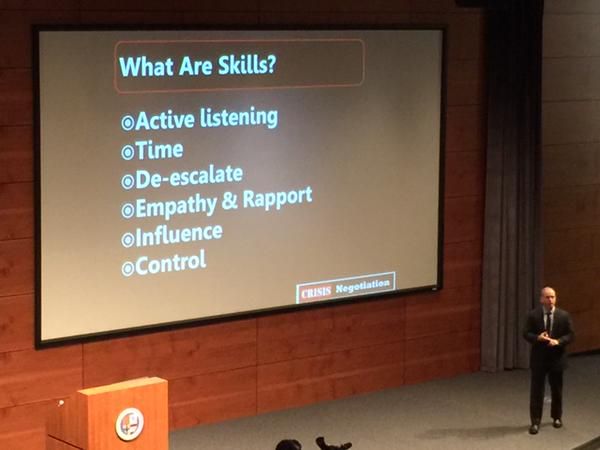
The 5 Core Skills Of Hostage Negotiators


The goal in law enforcement crisis situations where crisis and hostage negotiators are being utilized entails influencing a behavioral change in someone in order to gain voluntary compliance. Although initially this statement might sound jargon-filled, it simply means using a set of skills to get a person to stop acting the way he or she currently is and getting that person then to act the way you want them to.

The following are the core skills taught in initial law enforcement crisis and hostage negotiation courses across the world. Although you as the reader most likely will never be negotiating with someone threatening suicide on the ledge of a bridge or claiming if their demands are not met they will take someone’s life, you deal with your own crisis situations daily. This ranges from decision-making strategies at work, giving directives to employees, making a sales pitch, negotiating terms of a contract (a house for example), and determining financial and budget plans.

The unifying factor is in crisis situations a person’s actions are being dictated by their emotions at the detriment of rational thinking. Therefore, an effective crisis negotiator seeks to reduce the negative emotions that are dictating the person’s actions and bring back a more rational thinking process by employing the skills below.

The skills are active listening, using time, demonstrating empathy and building rapport, influencing the other person, and the concept of control. Each skill is further discussed [HERE].


Thursday, October 15, 2015

Negotiating with a Paranoid Schizophrenic Subject

 BY:  Samuel A. Farina, Jr.
NYAHN President and Retired Deputy Chief of Rochester (NY) Police Department

On August 14, 2013 in St. Joseph, Louisiana, headlines on CBS news read the following, “The gunman in a fatal hostage standoff wrote that he was angry at his ex-girlfriend's family and believed they were responsible for a device in his head…”

20-year-old Fuaed Abdo Ahmed shot two hostages, killing one, at a rural Louisiana bank before state police ended the 12-hour long standoff by shooting him dead. Admed indicated during the negotiation that he had a device in his head and wanted to have it removed.  Fearing for the safety of the two hostages Admed held and who actively threatened to harm, a tactical solution was employed in an attempt to save the lives of the hostages.  It was learned during the hostage situation that Ahmed was diagnosed and suffered from Paranoid Schizophrenia. 

Schizophrenia is a chronic, severe, and disabling brain disorder that affects about (1) one percent of people all over the world. People with schizophrenia sometimes hear voices others don’t hear, believe that others are broadcasting their thoughts to the world, or become convinced that others are plotting to harm them. These experiences can make them fearful and withdrawn and cause difficulties when they try to have relationships with others.

Most individuals with schizophrenia are not violent; more typically, they are withdrawn and prefer to be left alone. However, studies indicate that except for those persons with a record of criminal violence before becoming ill, and those with substance abuse or alcohol problems, people with schizophrenia are not especially prone to violence.  There are other studies that suggest that probability of violence with schizophrenics is five times higher than those absent the disorder. About one-third of individuals with schizophrenia attempt suicide. Schizophrenia is treatable with both medication and therapy. 

Substance abuse significantly raises the rate of violence in people with schizophrenia but also in people who do not have any mental illness. People with paranoid and psychotic symptoms, which can become worse if medications are discontinued, may also be at higher risk for violent behavior. When violence does occur, it is most frequently targeted at family members and friends, and more often takes place at home.

Negotiators who engage someone who is schizophrenic will observe situations of thought disturbances, hallucinations, delusions and other departures from reality.  It is important to address this situation with a number of specific communication strategies in an effort to resolve the situation peacefully and, at the same time, having a tactical plan at the ready in the event there is a need to save hostages, especially family or friends of the subject.

As with all negotiations, communication strategies have a foundation in utilizing Active Listening Skills to build a trusting relationship through rapport building.  This will prove to be a significant challenge with someone who is schizophrenic.  Due to the paranoia that routinely exists with those who have schizophrenia, building relationship and trust probably will not develop.  Efforts to stall for time to promote fatigue will be your best strategy to resolve a crisis event.  Listen and provide empathy while being based in reality will allow for the subject tire.  Avoid arguing and keep the conversation ongoing to encourage ventilation, gain intelligence, gain an understanding as to the subject’s state of mind, and gauge their level of episodic condition. 

The negotiator should be asking questions such as:
  •             What medications are you taking?
  •             Are you taking your medications?
  •             Have you stopped taking your medication?
  •             What are the voices saying or what are they telling you?
  •             What are you seeing?
  •             Do you want to hurt yourself?

Access to a mental health professional as a resource to develop a personality and psychological profile would prove useful with understating medications and their effects, the psychological history of the subject and a more specific communication strategy.  Given the frustration that may exist with mental health care providers and those with mental illness who are in crisis, offering psychiatric services in the early stages of the negotiation may prove counterproductive. 

Mediations prescribed today for schizophrenia could have a timely effect if taken during a crisis event and the subject should be encouraged to take their prescription during the negotiation.  Often times the main reason for discontinuing the use of medications is a result of the adverse side effects that consist of such ailments as headaches, nausea, impotence and involuntary muscle contractions. 

Appealing to the subject’s emotion of having to live with hallucinations and/or delusions should be expressed.  Maintain reality and don’t fall victim to joining in with the subject’s distorted thinking or behavior.  Ask intelligent questions about the subject’s hallucinations or delusions specific to what they are experiencing. 

Know that during the negotiation with a schizophrenic you will be quickly be exhausted and frustrated by the situation.  An appeal to the subject’s ego will go a long way.  In addition, the use of the media as a means to publicly outline the paranoid’s concerns may be an option as a resolution strategy. 

These types of negotiations will prove to be the most taxing and mentally challenging.  It is important to stay in our own reality and not enter into the subject’s distorted world.  Stay true to the process of using time as a means to promote fatigue and continuous communication.  Constant risk assessment will be necessary with the schizophrenic especially when there is evidence substance abuse in combination of having hostages who are relatives/friends.  There may be a need to quickly transition to a tactical solution if there are communicated threats directed toward others.  Keep in mind suicide as a potential concern during the course of any crisis situation and have an affinity for extreme patience and enhanced flexibility. 

Monday, October 12, 2015

FBI’s most dangerous hostage crisis: The Vietnam veteran who stole a child


ON A cold January day in rural Alabama, a Vietnam veteran with a grudge against the world climbed on to a school bus, shooting the driver and abducting a five-year-old boy to his underground bunker.
Jimmy Lee Dykes, a 65-year-old former truck driver with a terrifying reputation, held Ethan Gilman captive for a week in what has been called one of the most dangerous and difficult hostage cases the FBI has faced.
More than two years on, The Wall Street Journal has gone back inside the heart-stopping standoff, using interviews, recordings, photos and documents to tell the story of an angry man with nothing left to lose. Dykes had no relationship with his two daughters and ex-wife, and had gained a reputation for his vicious treatment of local pets — threatening neighbours, and a deep resentment of the government.
...the FBI Critical Incident Response unit sent a Boeing 727 packed with criminal profilers, bomb experts, attack dogs, crisis managers and the Hostage Rescue Team, who set up at an old building that had been an antique store, restaurant and strip club.
Read more from News.com.au [HERE].