Friday, November 23, 2018

C-K officers learning skills to de-escalate crisis situations

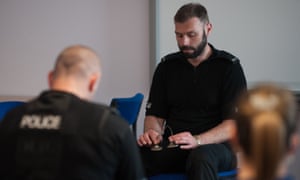
There were some hostage situations at a local hotel in Chatham on Thursday that Chatham-Kent police officers had to deal with, but there was no danger to the public.


There were some hostage situations at a local hotel in Chatham on Thursday that Chatham-Kent police officers had to deal with, but there was no danger to the public.
These scenarios involving actors is part of a five-day crisis negotiators course local officers are taking in Chatham, along with officers from Niagara Regional Police.
...Const. Fraser Curtis, an experienced negotiator, who is being re-certified, said crisis negotiation is a “perishable skill and obviously something that’s needed on the road from time-to-time when a call comes through where somebody’s in crisis.”
Tom Hart, president of Canadian Critical Incident Inc., with 20 years experience as a crisis negotiator with Durham Regional Police, is a course instructor.
“These type of people when they suffer these mental illnesses they’re in a state of crisis,” Hart said. “It’s really important for the officers to recognize those illnesses and develop a negotiating strategy to defuse, de-escalate and negotiate.”
Listening and de-escalating are key to successful negotiation, he said, followed by communicating clearly to the individual how resources will be used to resolve the situation.
Read more [HERE]. 

Tuesday, November 20, 2018

How to Control Your Emotions During a Difficult Conversation

nov17-30-808236772-Peter-Dazeley
It’s hard not to get worked up emotionally when you’re in a tense conversation. After all, a disagreement can feel like a threat. You’re afraid you’re going to have to give up something — your point of view, the way you’re used to doing something, the notion that you’re right, or maybe even power – and your body therefore ramps up for a fight by triggering the sympathetic nervous system. This is a natural response, but the problem is that our bodies and minds aren’t particularly good at discerning between the threats presented by not getting your way on the project plan and, say, being chased down by a bear. Your heart rate and breathing rate spike, your muscles tighten, the blood in your body moves away from your organs, and you’re likely to feel uncomfortable.


Focus on your body. Sitting still when you’re having a difficult conversation can make the emotions build up rather than dissipate. Experts say that standing up and walking around helps to activate the thinking part of your brain. If you and your counterpart are seated at a table, you may be hesitant to suddenly stand up. Fair enough. Instead, you might say, “I feel like I need to stretch some. Mind if I walk around a bit?” 

If that still doesn’t feel comfortable, you can do small physical things like crossing two fingers or placing your feet firmly on the ground and noticing what the floor feels like on the bottom of your shoes. Mindfulness experts call this “anchoring.” It can work in all kinds of stressful situations. For example, for a long time I was afraid of flying, but I found that counting while touching each of my fingers with my thumb helped to get me out of my rumination mode.

Read more and get all of the tips [HERE]. 

Saturday, November 17, 2018

'Very tense and very stressful': Crisis negotiators play pivotal role in recent standoffs with police

Winnipeg Police Service’s crisis negotiation team involved in several high-profile calls in last 3 weeks


The Winnipeg Police Service's crisis negotiation unit has dealt with several high-profile incidents over the past few weeks, including four armed and barricaded situations — two of those involving firearms.
"No two calls are going to be the same. Obviously, the deployment sort of ramps up your level of anxiety," said unit commander Staff Sgt. Sean Pollock.
"Really, you're just trying to establish communication. You're allowing that individual to express and vent," said Pollock.
Read more [HERE]. 

Wednesday, November 14, 2018

FBI Hostage Negotiation Tactics You Can Use Every Day

We have all read and trained on some of these techniques, but how many of us actual practice them and use them? Have a look...

Try the mirroring technique.

When in a negotiation it's crucial to get as much information out of the other side as possible. Voss explains that by "mirroring" them and simply repeating three to five keywords in their last sentence, people are forced by nature to repeat themselves in a way that gives more information and clarifies their points. An example:
Person 1: To get someone to tip their hand and clarify, simply repeat the last three to five keywords in their sentence.
Person 2: You repeat the last keywords?

Person 1: Yeah, pretty crazy right? What that does is it causes me to explain my point again from a different angle, revealing more information that could be extremely valuable and also it helps you decipher my true desired outcomes and motivations.
Voss notes it feels extremely awkward when you are doing the mirroring, but insists that the other person almost never notices and actually feels listened to. Voss refers to this as the negotiation "Jedi Mind trick" as he says it works every time and no one knows you're doing it.
Read more [HERE].

Monday, November 12, 2018

Manukau mall siege: Woman held hostage speaks of her horror

Laura Wheeler was in an Auckland Mall food court when a man came up from behind her and put a knife to her throat.


She said the man kept telling her quietly he didn't want to hurt her.

She said the man kept asking for his sister.

Wheeler said there were plenty of police officers facing off with the man, many who had drawn weapons.

However, only one spoke, a negotiator who Wheeler said did an "outstanding" job.

She said the negotiator told the man he could see his sister when he went back to the police station with them.

Read the full story and watch video footage at the NZ Herald [HERE].

Thursday, October 18, 2018

7 Traits of the Modern Sociopath and Psychopath

You hope to never negotiate or engage a subject with anti-social personality disorder but if you do, you better know about their common traits and symptoms. Have a look at the snippet below with the link to the full article at the bottom:
Antisocial personality disorder, sometimes identified interchangeably as sociopathy or psychopathy, is defined by the Mayo Clinic as: “A mental condition in which a person consistently shows no regard for right and wrong and ignores the rights and feelings of others. People with antisocial personality disorder tend to antagonize, manipulate or treat others harshly or with callous indifference. They show no guilt or remorse for their behavior.”
3. Lack of Empathy & Cold-Heartedness  
“Sociopathy is, at its very essence, ice-cold.”
— Martha Stout
Research by neuroscientist Adrian Raine reveals that people with antisocial personality disorder have fewer cells in their prefrontal cortex ― considered the most evolved region of the brain. The prefrontal cortex is responsible for, among many functions, the capacity to understand other people’s feelings (empathy), the capacity to make sound, principled judgement (ethics), and the capacity to learn from life experience (reflection).
As sociopaths/psychopaths lack empathy, ethics, and reflection, they also tend to be unfeeling and cold-hearted toward the pain and suffering they cause others. This lack of humanity has several dangerous implications:
A.  It compels the sociopath/psychopath to commit trespasses with little or no moral conflict.
B.  Knowing the suffering of their victims does not bring about ethical pause. Just the opposite ― it may encourage the sociopath/psychopath to do more harm (for they feel like they’re “winning”).
Read the full article [HERE]. 

Wednesday, October 17, 2018

'And breathe': police try mindfulness to beat burnout

Police officers will be taught mindfulness techniques such as slower breathing during the eight-week course.

This article can serve as a great reminder to those who constantly work in crisis situations that having a wellness/self-care plan in place is not just important, I would go as far as saying it is required. It can help you be more effective during crisis incidents as well as make you be calmer and overall more relaxed. [Here's some examples of mindfulness practices]

The College of Policing is to fund a trial of a secular version of mindfulness training for more than 1,500 officers in part to combat soaring stress and anxiety in the service, which has forced record numbers to take time off sick in the past year. Its backers hope to improve officers’ management of high-adrenaline confrontations, make them more alert when gathering evidence, improve listening skills when dealing with witnesses and victims and even help firearms officers make better decisions.

...There are early signs of possible effectiveness in policing. An initial trial in Bedfordshire suggested work-related-burnout was, on average, lower for 72 people who used the techniques and an internal report concluded: “Participants reported sleeping better, being able to reduce pain medication and feeling calmer and less reactive.”


...Stress is a serious problem for the police. Nearly 10,000 officers, equivalent to one in 12, took time off sick with stress or anxiety over the past year, according to figures released this summer.

Read the full article [HERE].

Tuesday, October 16, 2018

WSNA Annual Conference

The Western States Hostage Negotiators' Association

is excited to announce their 33rd Annual Training Seminar & HNT Competition.

April 7th, 2019 Negotiation Team Competition
Evening of April 7th, 2019 Registration & Networking
April 8th-10th, 2019 Training Seminar
Evenings of April 8th & 9th Networking/Team Building Events

The Historic Davenport Hotel, Spokane, Washington
WSHNA Room Rate is $119.00/night for both the
Historic Davenport Hotel and the Davenport Tower

Information at www.wshna.com, to include; registration, book your hotel rooms, presenter's bio's, presentation synopsis, event schedule, & Alaska Air discount. WSHNA is also on Facebook under our full name. Our web site will have all the latest information.

Monday, October 15, 2018

Two Signs Of A Panic Attack Coming On

Two Signs Of A Panic Attack Coming On post image

Empathy is critical to being an effective negotiator and helping someone through a crisis. Learn more about what a person is experiencing, especially the physical symptoms, when they are in the midst of a panic attack via the Psy Blog:

With panic attacks, people often report that they happen spontaneously, without being cued by anything specific.
But this research suggests they are a result of being very vigilant to relatively small fluctuations in heart rate and breathing that build up over up to an hour.
...The classic psychological signs of a panic attack are:
  • feeling of unreality,
  • fear of losing control,
  • and fear of dying.
The physical signs are:
  • shortness of breath,
  • heart racing,
  • dizziness,
  • chest pain,
  • sweating,
  • hot flashes,
  • trembling,
  • choking,
  • nausea,
  • and numbness
Read more [HERE]. 

Sunday, October 14, 2018

Crisis Counselor Skills: Helping People In Crisis… in 160 Characters or Less


I've heard in the past that it is not possible to build rapport with a subject through text and the goal is to try and convince the person to pick up the phone. 

That is simply not true. You can build rapport via text messaging.

Is it harder to build rapport via texting with a person in crisis compared to face to face or via the phone? Sure, at least initially without any practice or training. 

What am I basing this on? Crisis Text Line has exchanged more than 75 million messages in the past five years with people in crisis all via text messaging. With that massive amount of messages, it provides a massive amount of data. Fortunately it also provides some tips for us on how best to communicate with someone in crisis via texting. 

One thing to keep in mind is if communicating via text is what the subject feel most comfortable with, do we want to repeatedly try to convince them to use another mode of communication? 

To put it into perspective, if we are taught not to continually ask the person to come out and talk face to face (really surrender) when talking with a subject on the phone, why would we continually ask the subject to answer the phone continually via text messaging? Instead, the same process of slowing it down is used by crisis counselors similarly to what crisis negotiators use. 

From the article:

The four key skills used by CC’s (crisis counselors) are validating, strength ID’s, empathetic responses, and paraphrasing. Keep in mind each message is a maximum of 160 characters so each message a CC sends has to be well thought and concise. A Crisis Counselor also has to be cool under pressure as in some instances the person can be suicidal. The job of a Crisis Counselor is clearly not for everyone.
Validating: This lets the texter know that it is ok to be feeling what they are feeling. This could include a variety of emotions such as stress, anger, devastation, or feeling overwhelmed or abandoned. The CC tells them it is normal to feel that way based on what they are experiencing. The only way to get that information from them is by using questions that are not judging or accusatory but rather frequently open-ended. This invites them to share what is going on.
“It’s understandable you’re feeling stressed with all these deadlines looming.”

Read more about each of the above skills and how it can apply to your work [HERE]. 

Saturday, October 13, 2018

Hostage in Trader Joe’s Standoff Describes Helping Suspect Negotiate His Surrender


I highly recommend reading the full article, watching the above video and listening to the podcast below. Some might think by reading the headline that this is the case of Stockholm Syndrome. It is clearly not. (Read more on Stockholm Syndrome here).

It is something that I would describe more as a term I coined "Sydney Syndrome"- where the hostage works towards building rapport with the hostage-taker in order to increase their own survival chances. The hostage is not aligning with the hostage-taker from an affiliative perspective but rather one that realizes their fates are interconnected and it is therefore strategic to act in such a manner.

"Sydney Syndrome" is not a formal diagnosis (nor is Stockholm Syndrome), it is merely a term designed to help us further understand the actions of the hostage(s) during an incident. This is important as their actions (or inactions) can greatly impact the negotiation process. (if you are interested in reading paper, send me an email).

Here's a snippet from a hostage's account from an incident many of us are familiar with:

Standing near the registers at Trader Joe’s, MaryLinda Moss threw herself to the ground when she heard the sound of gunshots.

She called her 14-year-old daughter, who was waiting inside their car in the parking lot. “I said ‘There’s a shooter, hide in the bottom of the car,’ and then I hung up.”

It would be another three hours before Moss left the store.

The 55-year-old artist and art consultant would come to play a crucial role in helping Gene Atkins, 28, negotiate with police as dozens were held hostage inside the Silver Lake grocery store on July 21.

In an interview with KTLA’s Frank Buckley, Moss described those first few moments of chaos and a gradual, measured set of negotiations that took place over multiple phone calls with police in the hours after. 


Here's a description of the exchange between Mary Linda Moss and the hostage-taker:

She said, ‘There’s a woman who’s been shot, and he said, ‘That’s not my fault, that was the police,'” she said. “And I was like, ‘OK, but she’s gonna need help.'”

He told her, “‘You’re pushing’ or ‘you’re going too fast,'” she recalled.

He would repeat those phrases several times, later, as she helped him negotiate with police.


And here's one more:

“He’s saying, you know, ‘It’s all over. I shot at a cop. I’m in for life,'” she said. “And, I said, ‘There’s always hope.'”
Read more [HERE]. 

Listen to the podcast interview below: 

Friday, October 12, 2018

AFSP Voices of Hope: Before A Suicide Attempt


Have a look at this video published by the American Foundation for Suicide Prevention. It is first-hand, real-life accounts from people who attempted suicide. It is very moving and specifically for negotiators, it can provide insight and empathy to help you genuinely engage a subject that is suicidal.

Wednesday, October 10, 2018

Understanding Acute Stress Disorder

Image result for acute stress disorder

I'd say many of us are familiar with PTSD and its corresponding symptoms. However, are you also familiar with Acute Stress Disorder? As negotiators and practitioners from other related fields (like crisis counselors), we are not involved in the crisis to diagnose someone.

Why? It's not our job. 

Plus, for example we, as the communication specialists on the scene, are not going to try and determine if the certain symptoms are present in the subject for a specific time frame such as more than a month (required by the way for PTSD to be diagnosed) as that can come across as awkward and ruin the rapport-building approach.

What is important is to know the signs and symptoms in order to develop an effective communication strategy.

Therefore, I suggest get to know a little bit more about what Acute Stress Disorder is (from Health Line):

In the weeks after a traumatic event, you may develop an anxiety disorder called acute stress disorder (ASD). ASD typically occurs within one month of a traumatic event. It lasts at least three days and can persist for up to one month. People with ASD have symptoms similar to those seen in post-traumatic stress disorder (PTSD).

The symptoms include dissociative, avoidance, and re-experiencing the traumatic event. It also involves distress and also anxiety or increased arousal. Examples include:
  • having trouble sleeping
  • being irritable
  • having difficulty concentrating
  • being unable to stop moving or sit still
  • being constantly tense or on guard
  • becoming startled too easily or at inappropriate times
Read more on this including more symptoms [HERE].  

Tuesday, October 9, 2018

Negotiating with the Islamic State and Al-Qaeda


The first condition to negotiate with any party is to accept them. Is the Islamic State ready to acknowledge Western governments especially America? 

The Islamic State explicitly calls outsiders as apostate and infidels in its publications. It is the enemy of homosexuals and the Jews, and enslaves non-Muslim women. This group doesn’t approve of the United Nations or any other international organization, and wants to establish a universal Islamic government. Will the credibility of Western countries and the United States regarding human rights be questioned should they negotiate with Al-Qaeda, the Islamic State, and other Islamist internationalist groups?

...Negotiating with any group does not lead to being influenced by that group’s ideology. However, it gives credibility to that group. Why negotiate with Al-Qaeda and ISIS, given the fact that they have killed innocent civilians and enslaved countless women and girls?

Read more from International Policy Digest [HERE].