Saturday, October 21, 2017

The Use of Negotiators by Incident Commanders


Many involved in crisis/hostage negotiation will find this report useful. It provides incident commanders the insight into crisis negotiations, how negotiators work, their team set-up, and other information. Download the PDF of the full report [HERE] and you can read the foreward below.


Friday, October 20, 2017

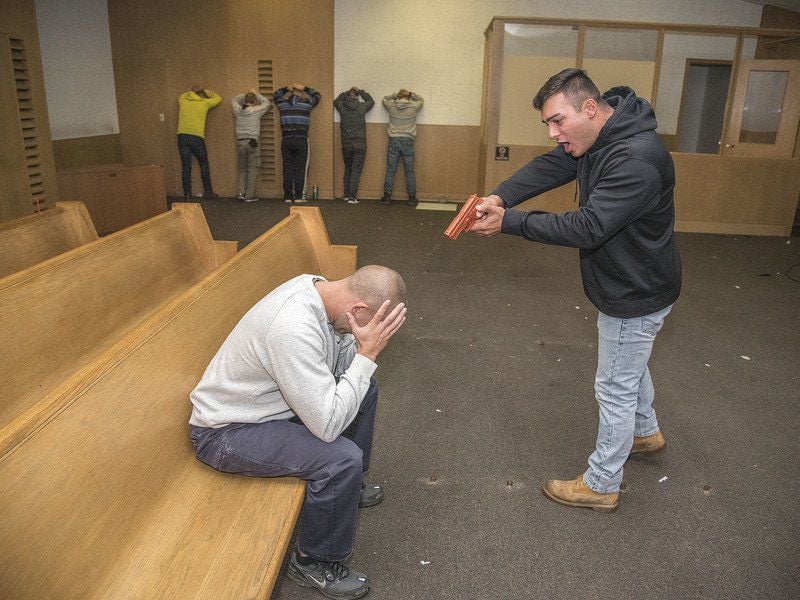
Falls police take dramatic approach to hostage training


(Niagara-Gazette.com)- The scenes were ripped from the front pages of America’s newspapers.
A high school student, distraught over his mom’s affair with his favorite teacher and plans to move away from his father, takes his classroom hostage at gunpoint.
A welder, with an ill wife and nearing retirement, is fired from his job while the boss’ buddy stays employed. His response is to kill the boss and take other employees at the company hostage. 
Falls Police Hostage Team negotiators and members of the department’s Emergency Response Team encountered both scenarios during an intense day of training of Thursday.
“Time is on our side,” Lt. Ron Cirrito, a hostage team commander, said. “As long as nobody’s getting hurt, we’ll keep talking.”
Watch the video [HERE].
Read more [HERE]. 

Thursday, October 19, 2017

When should we negotiate with terrorists?

Q Magazine spoke with Australian Adam Dolnikexpert in negotiation techniques, about the prisoner’s dilemma and the „red line” that governments are willing to overcome when initializing the dialogue with terrorist groups. 

Is negotiating with terrorists a discrete form of diplomacy?
Discrete, but with a very specific purpose. If done well, it can also lead to other things that can be beneficial in the wider context of the counter-terrorism grand strategy.
When such negotiations should take place?
Negotiation is simply about exercising influence over the other party’s behaviour or decision-making through the process of communication. As soon as contact with the kidnappers is established, communications should begin in an effort influence how the hostage is treated, and what his or her eventual fate will be.
What kind of terrorists are susceptible to negotiations?
Generally speaking, terrorists with tangible goals. In reality this depends less on the „type” of terrorists one is dealing with, and more on the concrete objectives they have with respect to the hostage taking in question. ISIS for instance released 17 hostages for ransom payments, and from that perspective the group was susceptible to negotiation. But later with the British, American, Japanese hostages, as well as Jordanian pilot – ISIS never had any intention of negotiating their release, they were never interested in having their declared propaganda and financial demands met. They simply wanted to murder these hostages as part of their gruesome soap opera.
Read the full article [HERE]. 

Wednesday, October 18, 2017

Alleged Amanda Lindhout kidnapper tries to explain inconsistencies, despite taped evidence

Ali Omar Ader says he wasn't a negotiator, just a captive ordered to make ransom requests


In the last day of testimony in the Amanda Lindhout kidnapping trial, the Crown poked holes in the story of the alleged negotiator who handled many of the details of the ransom payment that led to the Canadian journalist's release.
Ali Omar Ader, the Somali man lured to Canada by an undercover RCMP officer promising a book deal, told Ontario Superior Court in Ottawa on Wednesday that he himself was held captive by the extremist group that abducted Lindhout and Australian photographer Nigel Brennan in the Somali capital of Mogadishu. The pair were held for 15 months before being freed by their kidnappers on Nov. 26, 2009.
Read more from CBC.ca [HERE]

Tuesday, October 17, 2017

Shut Up and Listen


If you are having a hard time resolving a disagreement or a conflict with someone in your life, you might want to take some advice from Christopher Voss. He spent 24 years working in hostage negotiation, with four of them as the FBI’s chief international hostage and kidnapping negotiator. 
Now retired, he teaches the FBI’s negotiating secrets to businesses. There is one technique he emphasizes above all others for successful completion of any negotiation. What is that one sure-fire secret negotiation technique?
Shut up and listen...
Read more from the Bay Times [HERE]. 

Friday, October 13, 2017

Western couple and children freed after five years in Islamist captivity


An American-Canadian couple and their three children were freed today after being held hostage in Afghanistan for five years by militants linked to the Taliban and al-Qaeda.

Caitlan Coleman, 31, who gave birth to all three children in captivity, and her Canadian husband Josh Boyle, 34, were being flown home after an operation by the Pakistani military with US intgelligence.

They had been held by the Haqqani network, a powerful Pashtun group that recruited Osama bin Laden in the 1980s and retains close links with the Taliban.

Read more from The Times [HERE].


(Update 10/22) In first sit-down interview, Caitlan Coleman tells of forced abortion, disputes official account of her rescue in Pakistan

“We were not crossing into Pakistan that day,” Coleman said on the grounds of an Ottawa hospital on Monday, and claims made by Islamabad and Washington that they were rescued Oct. 11 after crossing the border are false.

Read more from The Star [HERE].

Wednesday, October 11, 2017

Tappan Zee Bridge: Hostage negotiator recalls climbing the bridge to rescue a jumper


Local residents have memories of the Tappan Zee extending back to the bridge's inception, but few have memories as vivid as Joe Becerra, who climbed to the top of the bridge to rescue a reportedly suicidal person.

Becerra, an investigator and hostage negotiator for the New York State Police, does not love heights, but as he told The Journal News/lohud.com, he did what he had to do.

Watch the video from LoHud.com [HERE]. 

Monday, October 9, 2017

Police drive to recruit volunteers is 'a recipe for disaster'


(DailyMail.com)- A national drive to recruit thousands of volunteers to fill key police roles was branded a ‘recipe for disaster’ last night.

Chief constables are spending £600,000 on drumming up an army of free labour to carry out scores of specialist roles.

Among the posts are jobs supporting elderly crime victims, monitoring CCTV networks, undertaking mounted patrols and even hostage negotiation.

Read more [HERE]. 

Tuesday, September 19, 2017

The Concept of “Control” & How Lacking It Can Lead To A Crisis

How Successful Hostage Negotiators Help A Subject Regain Control & Achieve A Peaceful Conclusion


Often, when a person is in a crisis they feel like they have no control over their situation. Due to this perception of their life being out of control, it contributes to the person (or “subject” in crisis/hostage negotiation jargon) acting out of a combination of numerous negative emotions such as anger, fear, frustration, rage, despair and sadness.

These overwhelming emotions and sensing their situation is hopeless can prevent the person from acting rationally and being open to listening to others, being influenced by them or considering alternative options. 

For a suicidal person, the subject then might see completing suicide as their only option. For a barricaded perpetrator surrounded by police, they might believe their only option is to “never come out alive” or exiting their position in a hail of gunfire.

Not that crisis and hostage negotiators need a reminder but this line of work is not easy. The above description is intended to generate empathy with the subject. Being able to “see things” from the eyes of another person is critical to eventually influencing them to gain their voluntary compliance. Remember that is the goal, as the alternative is involuntary compliance and that more than likely will involve some sort of force being used. 


In crisis situations, emotions can dictate a person's actions at the detriment of rational thinking.

If the subject feels as if they have no control, in order to be able to attempt to successfully influence them to do what you want (while they think they are making that choice themselves), you must help them regain a sense of control over their lives and their current situation. The Crisis Text Line calls this moving a person from a “hot moment” to a “cool calm.”

So how do you help a subject regain a sense of control over their situation?

Read the full article at PsychologyToday.com [HERE]. 

Sunday, September 17, 2017

Mental Health Emergencies: A Guide to Recognizing and Handling Mental Health Crises


(From Amazon.com)- Ready reference to mental and emotional health crises and concerns, providing overviews and expert guidance on more serious problems. Ideal for first-responders, teachers, counselors, and human resource professionals.

Developed from best-practices of psychiatry, psychology and mental health counseling, Mental Health Emergencies is a guide to providing much-needed care and support to the people in distress who most need help including self-injury, eating disorders, substance abuse, psychosis, and suicidal thoughts.

Mental Health Emergencies will help you provide exactly the right kind of support--where and when it's needed most.

Check it more and how to purchase different versions [HERE]. 

Friday, September 15, 2017

Closing the Gap: Assessing Responses to Terrorist-Related Kidnap-for-Ransom


This paper examines kidnapping as a source of terrorist finance, arguing that a new approach is needed if terrorist groups are not to continue to benefit from multimillion-dollar cash injections.
This paper outlines three different options which would help to ‘close the gap’ between the commitments of some governments and their actions in response to the kidnapping of their citizens by designated terrorists.
  • The first option requires a global, rigorously applied and scrupulously monitored commitment to prevent any concessions to terrorist organisations. This would eliminate hostage-taking as a source of terrorist finance, although terrorists might still kidnap for propaganda purposes. However, the paper shows that the international community remains polarised and is not ready to commit to enforcing such a ban. 
  • A second option is that governments exit from the market for hostage negotiations and decriminalise private resolutions of terrorist hostage incidents. The insurance sector already offers effective solutions for the prevention and resolution of criminal kidnappings. These solutions would become available for those exposed to the risk of terrorist kidnap. 
  • A third option would be a new policy framework modelled on existing private sector solutions. Private entities would be allowed to make financial concessions, but governments would create effective (multilateral) institutions to monitor and minimise such payments. 
Read more and get the link to download the full paper [HERE].

Thursday, September 14, 2017

KY officers train in expert hostage negotiation

Practice the way you play, Play the way you practice

ELIZABETHTOWN, KY (WAVE) - Hostage negotiators from a dozen Kentucky police agencies are being tested on advanced negotiating skills.
The Elizabethtown Police Department hosted national training from Crisis Systems Management out of Missouri the week of Aug. 21 to 25.
Read more Wave3.com [HERE] but first ask yourself- when was the last time your participated in a role-play exercise? You only know that you know you have the skills if you prove it... to yourself.

Wednesday, September 13, 2017

RUSI Report on Terror Ransom Payments Says Americans Are at Risk

LONDON — American hostages are at greater risk of being murdered or tortured because some European nations pay multimillion-dollar ransoms to terrorist groups, a think tank warned Tuesday.

The U.S. has a policy of not paying ransoms to banned militant organizations, a principle it has stood by through the high-profile beheadings of several Americans by ISIS.
Terrorists abuse hostages whose governments refuse to negotiate in order to raise the pressure on countries which do
Read more [HERE]. 

Friday, September 8, 2017

High-Tech Tools Used To End Standoff


Twitter was the method used by the Vermillion Police Department at about 8:30 p.m. Thursday night to initially inform the public that a standoff with a jail escapee that had gone on for hours in Vermillion had ended.

“Barricaded suspect situation has ended, Charles Mix County escapee Jubal Grant is in custody,” the Vermillion Police Department tweet states.

Social media was just one of the high-tech tools used by law enforcement that day to eventually get Jubal Grant back behind bars. Everything from a drone to a robot equipped with a video camera and a two-way radio were among the tools used by officers that allowed Thursday’s incident to end with the best possible outcome, said Vermillion Police Chief Matt Betzen.

Read more from PlainTalk.net [HERE].