Showing posts with label law enforcement. Show all posts

Friday, January 18, 2019

Offering hot chocolate behind an armored car: How Washtenaw’s crisis negotiators spent a busy year

ANN ARBOR, MI - Semi-automatic weapons and an armored truck surrounded the home.
They’d been there for hours, ever since a woman climbed out of a window that morning, fearful of her roommate. He was threatening to blow the place up, police said, and he wouldn’t come outside.
Then, he did. For a cigarette.
The crisis negotiators on scene had offered it, officials say.
It’s one of a number of tactics at the disposal of the Washtenaw Crisis Negotiation Team, in concert with Washtenaw Metro SWAT, to end crises such as that Oct. 30 barricade situation in Ypsilanti Township, said Washtenaw County Sheriff’s Lt. Nancy Hansen, negotiation team commander.
Weeks later, via megaphone, negotiators offered a barricaded man hot chocolate.
"Hey, it works," said Hansen, laughing briefly as she recalled some teasing the move incited. "So whatever works, as long as nobody gets hurt."
Read the full story about the busy year the team had at MLive.com [HERE]. 

Monday, January 14, 2019

Hostage Negotiation Competition simulates stress, challenges faced by law enforcement

More than 300 law enforcement officers will converge on Texas State University January 14-17 for the 29th Annual Hostage Negotiation Training and Competition.


Newswise — More than 300 law enforcement officers will converge on Texas State University January 14-17 for the 29th Annual Hostage Negotiation Training and Competition.
The hostage negotiator's skill set may not be well-known to the general public, but is essential to ensure public safety. After nearly three decades, the program's reputation is second-to-none, and provides critical training to police departments both national and international. Approximately 30 teams will participate in 2019, with municipal and state law enforcement units coming in from across the U.S., including representatives from New England, California, Oregon, Oklahoma, Ohio and Florida, said Wayman Mullins, a professor in the Department of Criminal Justice and an expert in hostage and crisis negotiations and terrorism. International teams from Canada and Singapore will also participate.
Monday and Tuesday are dedicated to classroom sessions and seminars. Wednesday and Thursday will see the teams conducting mock hostage negotiation exercises, where they'll be graded by top experts in the field.
"Negotiators save lives," Mullins said. "They come here for the training. The better trained they are, the better they do their jobs.
"If you look at the national data, once negotiators respond to a critical incident, their success rate is about 97-98 percent," he said. "What that means is that once we start talking, innocent people don't get hurt or killed. Police officers don't get hurt or killed. The bad guy doesn't get hurt or killed. That's all the justification you need for making these negotiators better at what they do."
Violent hostage situations as depicted in television and movies are a relatively rare occurrence, but negotiators deal regularly with other scenarios demanding their skill set, Mullins explained. Barricades situations happen when, for instance, police attempt to serve a warrant and the intended recipient blocks the door and threatens to shoot anyone who enters. Other times, domestic conflict can escalate to a person taking family members hostage. High-risk suicides are another instance where negotiators become involved with the goal of preserving life.
Law enforcement teams will conducting mock hostage negotiation exercises on Wednesday and Thursday. The teams work in one room, with university faculty playing the role of antagonists in another.
“They’ll be graded on how they negotiate with the hostage takers,” explained Mullins. “This is a role-playing scenario that tries to mimic real life as much as possible.”
The chosen scenario unfolds during the back-and-forth communication between the two groups, with some of the top experts in the field evaluating the teams' performances. All participants receive a standardized evaluation with thorough feedback.
When not participating in the competition, teams are able to observe other teams at work, to learn from the different approaches taken to the same problem.
"Many of the participants will tell you that we add more stress in the competition than they experience in a real life situation, because their peers are watching them here," Mullins said. "The reality is that negotiators can be called on to use these skills at all times, and unexpected times.
"Many of these people have been coming here for more than 20 years," he said. "If we're not helping them, why would they keep come back?"
About Texas State University
Founded in 1899, Texas State University is among the largest universities in Texas with an enrollment of 38,694 students on campuses in San Marcos and Round Rock. Texas State’s 189,000-plus alumni are a powerful force in serving the economic workforce needs of Texas and throughout the world. Designated an Emerging Research University by the State of Texas, Texas State is classified under “Doctoral Universities: Higher Research Activity,” the second-highest designation for research institutions under the Carnegie classification system.

Saturday, November 17, 2018

'Very tense and very stressful': Crisis negotiators play pivotal role in recent standoffs with police

Winnipeg Police Service’s crisis negotiation team involved in several high-profile calls in last 3 weeks


The Winnipeg Police Service's crisis negotiation unit has dealt with several high-profile incidents over the past few weeks, including four armed and barricaded situations — two of those involving firearms.
"No two calls are going to be the same. Obviously, the deployment sort of ramps up your level of anxiety," said unit commander Staff Sgt. Sean Pollock.
"Really, you're just trying to establish communication. You're allowing that individual to express and vent," said Pollock.
Read more [HERE]. 

Sunday, June 3, 2018

Crisis Negotiator Skills: The Experts Weigh In

New research reveals what makes law enforcement hostage negotiators effective.


Recent research conducted on the skills law enforcement crisis and hostage negotiators believe that makes them effective has helped bridge the gap between the “science” and the actual “practice” of crisis negotiation. The findings of the study, published in Police Practice and Research(link is external) (Johnson, Thompson, Hall, & Meyer, 2017), identifies the skills that not only work during these tense, (potentially) volatile, and emotionally driven situations but also what these crisis negotiation experts also find to be ineffective.

The study provides the insight from nearly 200 law enforcement negotiators and below are some of the key findings.


First Impressions

There is a substantial amount of research in psychology connecting first impressions with building rapport and demonstrating empathy. Rapport and empathy are also both important to getting what you want.
First impressions are not just for blind dates either. In crisis situations the implications are much more serious and have a legitimate impact on the rest of the interaction. The research on this is referred to thin slice methodologyand I recommend you read more it (here for example). Remember, as you will see from the results first impressions involve verbal and nonverbal communication.
Law enforcement hostage negotiators place a significant amount of importance on how they look and how they begin their interaction with the subject (the person they are negotiating with).
  • Rarely do they say their rank (93% do not)
  • The majority do not say they are a negotiator (only 27% do)
  • The majority either “always” or “usually” (combined 64%) wear something that identifies themselves as negotiators
So what does this mean? If the negotiator is seeking to de-escalate the situation, how he or she begins the interaction is critical to setting that tone right away. Consider the difference between the following:
Read the rest of the article [HERE]
Get access to the research report [HERE]. 

Friday, May 18, 2018

Inside Central Texas Regional SWAT’s top-ranked crisis negotiation team


Just three years after its formation, the Central Texas Regional SWAT Crisis Negotiation Team won first place at the 28th annual Texas Association of Hostage Negotiators Competition at Texas State University in January.

“The men and women assigned to the Central Texas Regional SWAT Crisis Negotiation Team have worked diligently to establish a very reputable competency, generally associated with more mature, longer standing and more experienced teams,” said Georgetown Police Chief Wayne Nero. 

“I am very proud of their first-place achievement as it is a direct testament to their ongoing hard work and dedication as well as the successful collaboration across agencies.”

Read more from CommunityImpact/ [HERE].


Tuesday, February 27, 2018

An Inside Look At Portland Police Bureau's Crisis Negotiation Team


PORTLAND, OR (KPTV) -FOX 12 is getting an inside look at the Portland Police Bureau's Crisis Negotiation Team. 
A team of a highly trained officers that are called to deescalate tensions and save hostages in some of the most dangerous situations.  
When these types of incidents happen, people often only see Portland's SERT team in action. But, the CNT is on scene too just not as visibly.
Watch the video and read more [HERE].

Sunday, January 21, 2018

Lubbock PD negotiators compete in crisis negotiation competition in San Marcos

... Young said another component is the personal nature of what the negotiator team does.
“We’re there to try and help people as much as they’ll allow us to help them,” he said. “I think the citizens benefit from knowing that the police department is not here just to put people in jail or to kick in doors, but we’re actually here to try and help people on, sometimes, their worst day.”
Read more [HERE]. 

Saturday, October 21, 2017

The Use of Negotiators by Incident Commanders


Many involved in crisis/hostage negotiation will find this report useful. It provides incident commanders the insight into crisis negotiations, how negotiators work, their team set-up, and other information. Download the PDF of the full report [HERE] and you can read the foreward below.


Thursday, May 11, 2017

NWA Law Enforcement Host Hostage Negotiation Training


...Lt. Derek Wright with Springdale Police said it takes a special kind of officer to be a negotiator, and not anybody can do it.
 "So what we look for are officers that go beyond just listening to someone. We try to understand where they are mentally and emotionally and why they are there, what caused them to be where 
they are right now. Once officers can understand that and our negotiators get to that point we can work for the best solution and for whatever can help that person get out of that crisis situation," Wright said.
Watch the video and read more [HERE]. 

Tuesday, April 11, 2017

Seattle PD negotiators take to the web to explain tactics in Tuesday's crisis call


SEATTLE - As the man paced up and down Third Avenue, armed with a knife, Seattle police Detective Beth Wareing tried to have a conversation with him by yelling across the street.
Wareing, a member of the department’s hostage negotiations team, said she didn’t think about the honking, the perturbed commuters or how the incident was disrupting the Tuesday evening commute. Her sole focus was getting the distraught man to drop the knife and listen.
“Basically, it was reaching out to him and reminding him he had things to live for and he had people who cared about him,” Wareing said Thursday.

...Waltz and Wareing used the Reddit forum to explain that negotiations are about “building a connection” with people in crisis and that there’s no “magical word or phrase that causes people to give up.”
Read more at Komo News [HERE]. 

Sunday, March 26, 2017

Las Vegas Strip reopens after lengthy standoff with ‘delusional’ gunman on bus

L.E. BASKOW

Parts of the Las Vegas Strip were closed for more than four hours today as Metro Police negotiated with an apparently “delusional” man suspected of killing one person and wounding another in a late morning shooting on a double-decker bus.

The man barricaded himself inside the bus near the Cosmopolitan which forced police to shutdown the Strip from Flamingo Road to Harmon Avenue while negotiating his surrender.

Read more from the Las Vegas Sun [HERE]. 

Monday, March 13, 2017

Mental health team to work closely with SFPD during crisis


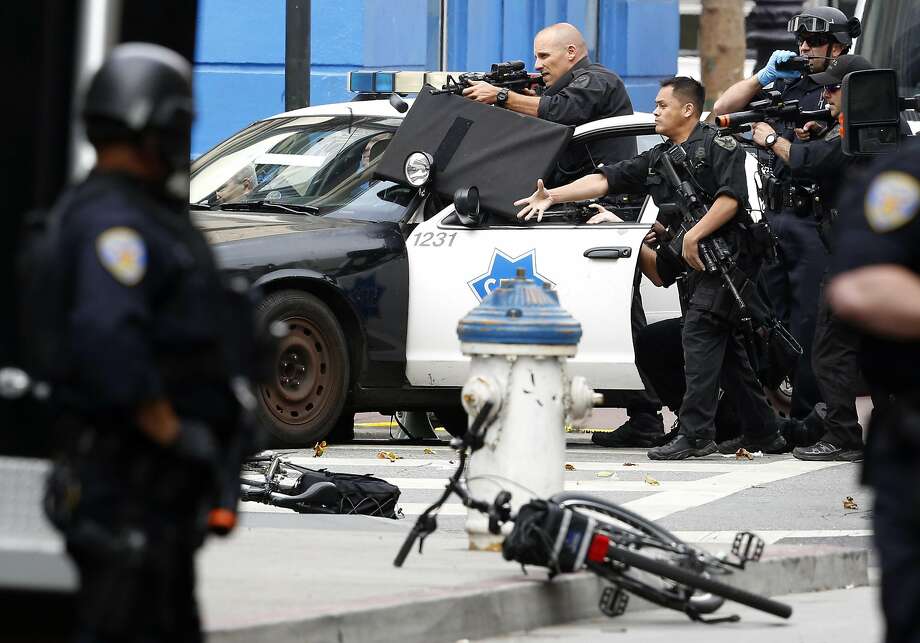
(SFexaminer.com)- San Francisco police shut down several blocks of Valencia Street on Friday because Samantha Helstrom, 57, had barricaded herself inside her Mission District home.
The seven-hour negotiations were lead by the department’s Hostage Negotiation Team, but a Department of Public Health employee was on the scene, too, as is often the case in such instances.
...The newly expanded DPH team that will work with SFPD is part of that effort. 
“Their role will be for advice” Molina told the Police Commission March 8. “It’s a work in progress, but I think we’re getting there.”

The department’s team focuses on prevention by identifying the people most often in crisis, tracking their cases and dealing with the crisis. When a crisis occurs, the department will call on one of the DPH’s team members. That person will aid the hostage negotiators on the scene.

Read more [HERE]. 

Sunday, March 12, 2017

Despite Notoriety of Colorado Street Bridge, Pasadena’s Suicide Rates Have Declined


(PasadenaNow.com)- The City’s Public Health Department announced that Pasadena’s annual suicide rates have declined in recent years, even as the Colorado Street Bridge seems to be drawing an increasing larger number of the distraught.

...The report indicates that Colorado Street Bridge, which earned its reputation as “Suicide Bridge” during the Great Depression, only accounted for 27 of the 177 total deaths since 2006.


...The Pasadena Police Department leads a Crisis Negotiation Team that has 14 members consisting of one Lieutenant, two Sergeants, three Corporals, two Dispatchers, one Park Safety Specialist, and five Officers to respond to individuals in need, according to Lt. Vasken Gourdikian.

The team is a voluntary assignment, says Gourdikian, with no time limit or constraints in terms of number of years, and it is considered an “absolute specialty” by the police department.

Read more [HERE]. 

Monday, February 6, 2017

Not ‘Lone Wolves’ After All: How ISIS Guides World’s Terror Plots From Afar

Emanuel L. Lutchman was told by his ISIS handler to attack a bar in Rochester on New Year’s Eve in 2015, the authorities say. Credit Carlos Ortiz/Democrat & Chronicle, via Associated Press        
 
(NYtimes.com)- ...As officials around the world have faced a confusing barrage of attacks dedicated to the Islamic State, cases like Mr. Yazdani’s offer troubling examples of what counterterrorism experts are calling enabled or remote-controlled attacks: violence conceived and guided by operatives in areas controlled by the Islamic State whose only connection to the would-be attacker is the internet.
 
In the most basic enabled attacks, Islamic State handlers acted as confidants and coaches, coaxing recruits to embrace violence.
 
...For the most part, the operatives who are conceiving and guiding such attacks are doing so from behind a wall of anonymity. When the Hyderabad plotters were arrested last summer, they could not so much as confirm the nationalities of their interlocutors in the Islamic State, let alone describe what they looked like. Because the recruits are instructed to use encrypted messaging applications, the guiding role played by the terrorist group often remains obscured.
 
As a result, remotely guided plots in Europe, Asia and the United States in recent years, including the attack on a community center in Garland, Tex., were initially labeled the work of “lone wolves,” with no operational ties to the Islamic State, and only later was direct communication with the group discovered.
 
Read the full article from the NYTimes.com [HERE].

Wednesday, January 4, 2017

SF police see progress in dealing with people in mental crisis


(snippets) The San Francisco police hostage crisis negotiation team responded to more calls in 2016 than in any year in recent history, an uptick that officials see as a sign that the department is moving in the right direction in dealing with people suffering from mental health crises.

“We’ve all taken to heart de-escalation, the sanctity of life and trying to negotiate a peaceful resolution so that no one needs to get hurt, either the officers or the public or the suspects,” said Sgt. Lisa Frazer, acting officer in charge of the hostage crisis negotiation team.

Among the hostage team’s cases in 2016 were calls about a suicidal man with a gun in the Tenderloin, a 13-year-old autistic boy armed with a knife in the Mission District, a 25-hour standoff in the Ingleside neighborhood with a barricaded robbery suspect, and a four-hour-long incident involving a man with outstanding warrants who was in the water under Pier 48. All the incidents ended peacefully.

Once a specialized crisis-intervention team is operational, much of the burden will be lifted from the hostage team. Frazer said the process has already begun: In at least seven incidents in 2016, the hostage team was on its way — only to learn that the officers on scene had resolved the situation using de-escalation tactics.

Read more from the SFchronicle.com [HERE]. 

Monday, December 19, 2016

A DAY WITH HOSTAGE NEGOTIATORS


Martin Michaels is the pen name of a police lieutenant in Silicon Valley whose specialty is hostage crisis intervention.

...Our coffee break was interrupted by our radios blasting tandem alert signals. A teenage boy had just threatened to stab his mother at a local housing project. Back to work.

More information was broadcast over the radio as we headed that way. The boy was African-American, 6′2″ and 260 pounds. He had threatened to stab his mother with a large kitchen knife when she tried to make him go to school.

...The mother displayed symptoms of aggression and paranoia and was physically trying to stop the officers from entering the house to speak with her son, demanding they speak to him through her. I was able to eventually calm the mother down and she changed her story. 

Her son now never threatened her with a knife — he had only threatened to harm himself.

Now dealing with two different stories, both involving a weapon and erratic behavior, I rushed to re-brief my sergeant and go over the plan of contact: 

“We will have a negotiator talk to the teen from behind a shield,” I said. “Under no circumstances are we going inside the apartment. 

We need to defuse the situation and treat this as a mental-health intervention case, not a crime.”

Read the full story at OZY.com [HERE]. 

Thursday, December 15, 2016

Inside Look: How Hostage Negotiators Break Through the Mind Game


When there’s a life-or -death crisis, one word or one look can make or break the situation.

That’s why crisis negotiators are trained to get inside the minds of people in distress.

It's an intense job and really takes a special kind of person to want to do it and do it well.

On Nov. 2, Fadel Jabado, a father of six, allegedly shot his wife and son to death, and then his attorney.

Miami-Dade Police Crisis Negotiator Victor Millian was dispatched to a location where Jabado was held up. Millian was literally the last line of communication where anything could have happened.

“One of the things he kept telling us from the minute I started my conversation, he wanted us to kill him he wanted to be suicide by cop, he implored me,” said Millian.


Read more from NBC 6 [HERE].


Wednesday, October 5, 2016

WPD negotiator details talks between suspect following standoff

WICHITA, Kan. (KWCH) - The Wichita Police Department's Crisis Negotiation Team was called out at around 2:30 Friday morning for a standoff to help a woman that had a gun to her head.
This came after a short police chase that left one sheriff's deputy in the hospital. Behind all of the lights and sirens, negotiators began their work by talking with the officers that were already on scene.
"At this point we decided to go into a coaching phase where we actually coach the officer instead of taking over the negotiations because he'd already developed the rapport," said Christian Cory, a member of the negotiation team.
Read more and watch the video [HERE]. 

Saturday, October 1, 2016

More than just talk: Police discuss how words can diffuse situations

The No. 1 element in being a successful negotiator is you have to honestly care about the person on the other end of that phone,” 
Whitley, a 13-year member of the Danville Police Department and a crisis negotiator for around nine years, said. 
“My sole focus at that point and time is talking to him.”


For five hours, Danville Police were on the 100 block of Marshall Terrace negotiating a peaceful end to a hostile situation.
Andrew Steven Petrick, 35, was wanted for grand larceny and forgery warrants. When police attempted to make an arrest that morning around 10 a.m., he went into a residence and would not surrender.
Petrick told police he had a firearm and would not come out.
Read more from GoDanRiver.com [HERE].